
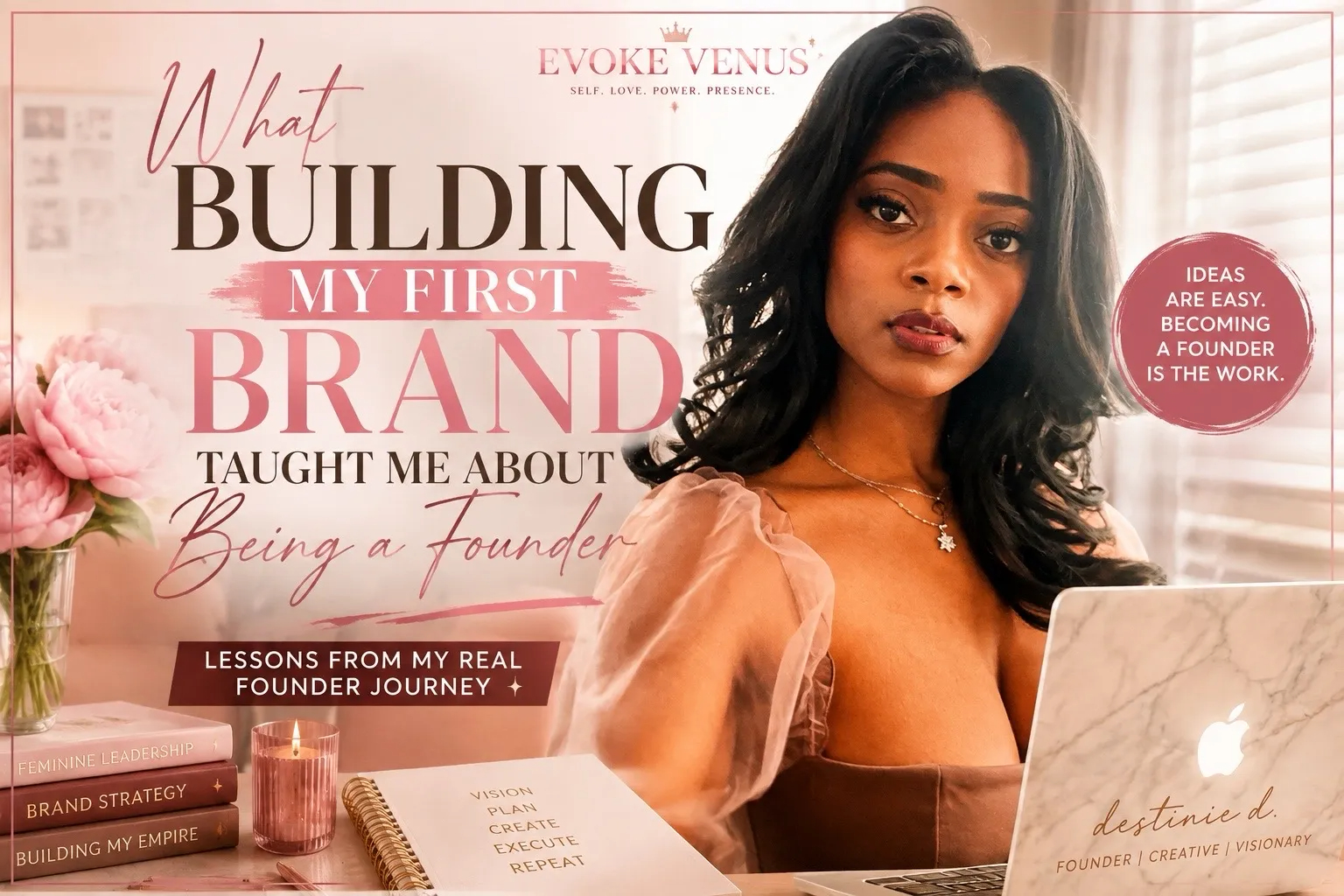
I think there is a version of entrepreneurship that looks beautiful from the outside.
The name.
The website.
The logo.
The carefully chosen colors.
The launch announcement.
The moment you finally get to say, I built this.
But building my first brand taught me that being a founder has very little to do with how beautiful something looks once everyone else gets to see it.
Being a founder is mostly about what happens before anyone cares.
Before the sales.
Before the recognition.
Before there is proof that the idea living inside of your head deserves to exist outside of it.
For me, that brand was Evoke Venus.
And while Evoke Venus has taught me a lot about women, identity, healing, creativity, desire, confidence, and expression, building it has taught me just as much about myself.
I started with ideas.
Then I realized ideas were the easy part.
The harder part was becoming the woman capable of building them.
I Learned That Having a Vision and Building One Are Two Different Things
I have never struggled with ideas.
If anything, I have too many.
I can imagine an entire world from one thought. I can see the colors, the language, the feeling, the story, the products, the photographs, the women it could speak to, and ten other things it could eventually become.
That is one of my gifts. It has also been one of my biggest lessons as a founder.
Because imagination can convince you that you are further along than you actually are. You can see something so clearly in your mind that it almost feels finished. Then you sit down to build it.
Suddenly there are websites to design, products to finish, descriptions to write, prices to choose, platforms to learn, emails to create, content to schedule, files to organize, pages to edit, links to fix, customers to think about, and a thousand tiny decisions nobody will ever know you made.
Vision says:
I know what this could become.
Building says:
Okay. What are you doing today to make it real?
Evoke Venus taught me that creativity gives you the world, but structure is what allows other people to enter it.
I needed both.
Nobody Tells You How Many People You Become When You’re Building Alone
One day I am a writer.
The next day I am designing a workbook.
Then I am researching SEO.
Then I am figuring out pricing.
Then I am writing product descriptions.
Then I am thinking about customer experience.
Then I am creating an article, developing a course, studying analytics, planning Pinterest content, fixing something on my website, or wondering why something that looked perfect yesterday suddenly looks terrible today.
And somewhere in between all of that, I am supposed to remain inspired.
That part makes me laugh now. Because when I first thought about owning a brand, I imagined being the creative director. I didn’t realize I would also be the intern.
And the marketing department.
And quality control.
And product development.
And customer service.
And the person responsible for figuring out why something isn’t working at 1:13 in the morning. Building my first brand gave me an entirely different respect for founders.
Especially founders who begin without teams, large budgets, investors, industry connections, or somebody handing them a blueprint.
You become resourceful because you have to.
You learn things you never planned on learning because there is nobody else in the room to pass the problem to.
There is a strange confidence that comes from that. Not the confidence of knowing everything.
The confidence of realizing:
I can probably figure it out. That might be one of the most valuable things Evoke Venus has given me.
I Learned That Nobody Has to Understand It Before I Build It
This was a big one for me.
When you are creating something unconventional, there is always the temptation to explain it until everyone else can see what you see.
You start asking yourself:
Will people understand this?
Is this too different?
Should I make it simpler?
Should I make it look more like what is already successful?
Should I change the language?
Should I choose one thing and stay there?
Eventually I had to realize that constantly translating my vision for other people’s comfort could destroy the very thing that made it mine.
Evoke Venus doesn’t fit perfectly into one category.
It is writing.
It is education.
It is reflection.
It is femininity.
It is psychology and emotional awareness.
It is sensuality.
It is storytelling.
It is visual expression.
It is products, essays, workbooks, courses, characters, conversations, and ideas.
At one point, I might have seen that as a branding problem.
Now I understand that learning how all of those pieces belong together is the work of building the brand.
A founder doesn’t always begin with something the world already has language for. Sometimes you have to build long enough for the language to reveal itself.
I Learned That You Can Waste a Lot of Time Trying to Look Ready
There is always another thing you can improve.
Always.
Another page.
Another design.
Another edit.
Another product.
Another photograph.
Another strategy.
Another platform.
Another reason to tell yourself, I’ll really start once I finish this. I have had to learn the difference between refinement and hiding. Perfectionism can look incredibly productive when you’re a creative person.
You can spend six hours changing things and convince yourself you worked for six hours.
Technically, you did.
But did you move the business forward?
That is a different question. There were moments when I had to ask myself whether I was improving something because it genuinely needed improvement or because improving it felt safer than releasing it.
A founder eventually has to let the public meet the work.
Not the imaginary future version.
Not the version with unlimited money, a full creative team, perfect photography, thousands of customers, and every resource you wish you had.
The version you can build now.
Then you build again.
I Learned That Your First Customer Cannot Be Your Only Source of Belief
There is a particular kind of silence that happens when you create something and put it online.
You refresh.
Nothing.
You post.
Nothing.
You change the caption.
Nothing.
You start wondering whether the idea was as good as you thought it was.
That is where entrepreneurship starts getting psychological.
Because if your confidence depends entirely on immediate validation, building a brand can emotionally exhaust you.
People don’t automatically care because you worked hard.
People don’t automatically buy because something is meaningful.
People don’t automatically understand how much thought went into something.
And the internet certainly doesn’t owe you attention because you created something beautiful.
That sounds harsh until you realize how freeing it is.
My job is to build.
My job is to communicate.
My job is to learn.
My job is to improve.
My job is to make it easier for the right person to understand why what I created matters.
But I cannot make every metric a referendum on my worth.
Sometimes the product needs work.
Sometimes the marketing needs work.
Sometimes the audience isn’t developed yet.
Sometimes people need to see something ten times before they remember it.
Sometimes the timing is wrong.
And sometimes you simply have to keep going long enough to collect enough information to know the difference.
Being a Founder Made Me Less Romantic About Business—and More in Love With Creating
I still love the beautiful parts.
Obviously.
I love creating worlds.
I love names.
I love concepts.
I love beautiful imagery, feminine details, storytelling, language, packaging an idea into something someone can hold, read, experience, or remember.
But I don’t confuse those things with the entire business anymore.
A beautiful brand with no structure is a beautiful idea.
A meaningful product nobody can find is still difficult to sell.
A large audience doesn’t automatically become customers.
Creativity doesn’t eliminate the need for strategy.
Passion doesn’t replace consistency. And being talented doesn’t exempt you from learning business.
If anything, building Evoke Venus has made me more protective of my creativity because I understand that structure gives creativity somewhere to live.
I don’t want to create beautiful things that disappear into my camera roll or sit unfinished inside my notes.
I want to build containers strong enough to carry my ideas into the world. That requires me to think like an artist and a founder.
I Also Learned That I Don’t Want to Build Only One Thing
Maybe this is the lesson that surprised me most. Building my first brand didn’t satisfy my desire to create.
It expanded it.
Once I understood that I could take something that existed only inside my imagination and give it a name, identity, website, products, language, audience, and purpose, something clicked for me.
I realized:
Oh. I can build worlds.
And I don’t think I am supposed to spend my life building only one.
Evoke Venus taught me the foundation.
It taught me how I think.
It showed me where I overcomplicate things.
It exposed where I hesitate.
It showed me what comes naturally to me and what requires discipline.
It taught me that some ideas are products, some are content, some are businesses, and some are simply beautiful ideas that don’t need to become anything else. That discernment matters.
Because being creative means I will probably never run out of things I could build.
Being a founder means learning which ones deserve my time.
The Hardest Part Has Been Learning to Trust Myself Without Becoming Attached to Every Decision
There is an interesting balance required in entrepreneurship. You have to believe in yourself enough to ignore people sometimes. But you also have to be humble enough to admit when something isn’t working. You have to protect the vision without worshipping the original plan.
Those are not the same thing.
I can change the website.
I can rename something.
I can discontinue a product.
I can change the price.
I can abandon an idea.
I can discover a better direction.
None of those things mean the vision failed.
I used to think changing direction meant I had gotten something wrong. Now I think iteration is one of the clearest signs that something is alive. Evoke Venus today does not look exactly like the first version I imagined/ Good. Neither do I.
My First Brand Was Also My First Real Business Education
I could have read about branding forever.
I could have watched videos about entrepreneurship. I could have studied marketing funnels, SEO, product development, content strategy, conversion, customer psychology, and business models. And all of that information would have been useful. But nothing has educated me like having something of my own on the line.
You learn differently when it is your money.
Your idea.
Your name.
Your reputation.
Your audience.
Your decision.
Your consequence.
Suddenly analytics aren’t abstract.
Marketing isn’t theoretical.
Brand positioning isn’t a chapter in a textbook.
You understand why people obsess over customer acquisition when you’re the one trying to acquire the customer.
You understand why clarity matters when you realize people have approximately three seconds to figure out what you’re selling.
You understand the value of systems after doing the same tedious task for the fifteenth time.
And you understand why successful founders talk about resilience so much. Because there are days when absolutely nothing dramatic happens.
Nobody applauds.
Nobody announces that you’ve officially become successful.
You simply wake up and continue building.
I Thought I Was Building Evoke Venus. Evoke Venus Was Building Me Too.
That may be the biggest lesson. There are versions of myself I would not have met if I had never decided to take my ideas seriously. Building something requires you to confront yourself.
Your relationship with money.
Your relationship with visibility.
Your relationship with failure.
Your relationship with criticism.
Your relationship with discipline.
Your relationship with uncertainty.
Your relationship with being misunderstood.
Your relationship with success.
Even your relationship with your own potential.
A business will find every place where you don’t trust yourself. And then it will give you another decision to make anyway. That is why I no longer see Evoke Venus as simply something I created. It has been one of the places where I have practiced becoming.
Becoming more decisive.
More disciplined.
More willing to experiment.
More comfortable being seen.
More capable of separating rejection from identity.
More willing to say, this isn’t working, without translating that into I am not working. And most importantly, more willing to believe that my imagination deserves infrastructure.
I’m Still Becoming the Founder
I don’t want to write this from the perspective of someone standing at the finish line.
I’m not.
There are still things I am learning. There are ideas I haven’t executed yet. There are strategies I will probably look back on and laugh at. There will be things I launch that work beautifully and things I launch that teach me exactly what not to do again.
That’s part of it.
I used to think you became a founder once you created the business. Now I think you become one through the thousands of decisions that come afterward.
The decision to keep learning.
The decision to adapt.
The decision to finish.
The decision to publish.
The decision to take yourself seriously before there is enough external evidence telling you that you should.
Evoke Venus was my first lesson in turning imagination into infrastructure. And maybe that is what being a founder means to me now.
Not simply having ideas.
Not simply owning something.
Not simply putting “Founder” beside your name.
It is accepting responsibility for bringing a vision into reality—and becoming capable of carrying what you asked to create.
I built my first brand thinking I was creating a place for my ideas. Instead, I created a place where I could finally see what I was capable of becoming.
Leave a Reply