
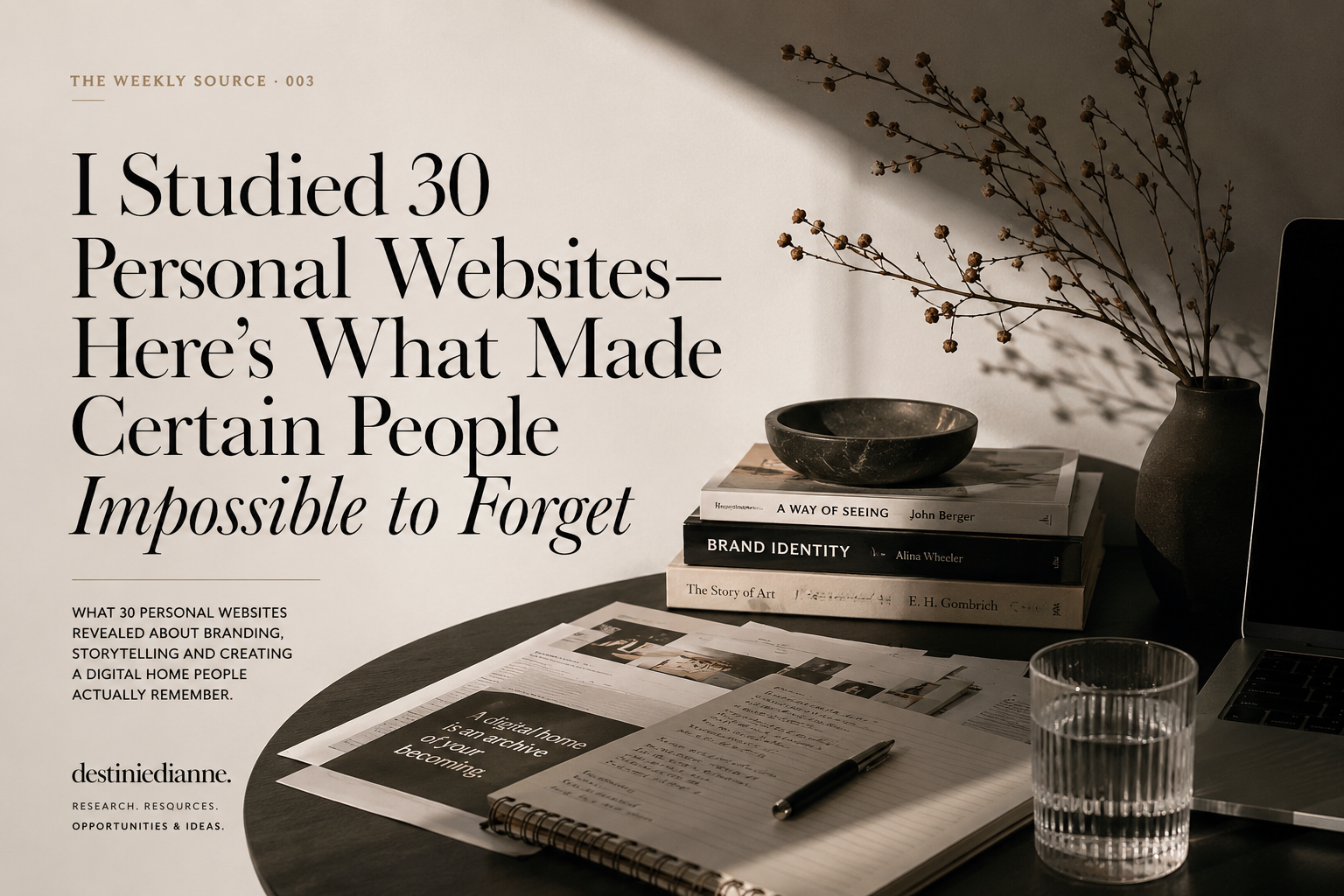
The personal websites I remembered weren’t necessarily the prettiest. They were the ones that made me feel like I had met someone.
THE WEEKLY SOURCE · 003
Researched & written by Destinie Dianne.
Research, resources, opportunities & ideas you don’t have time to find yourself.
I have a habit of studying people’s websites. Not casually looking at them.
Studying them.
I notice what they put first. What they call themselves. How they introduce their work. Whether I understand what they do within thirty seconds. Whether their website feels like a portfolio, a résumé, a magazine, a diary, a business—or somehow all five.
Most importantly, I notice whether I remember them after I close the tab.
So I recently sat down and intentionally studied 30 personal websites belonging to writers, founders, creatives, consultants, designers, artists and people building careers around their own names.
I wasn’t looking for the “best” website.
I wanted to answer a different question:
Why do I forget some people almost immediately while others stay in my head?
Because there are plenty of beautiful websites.
There are plenty of professional websites.
There are plenty of people with impressive résumés.
But being impressive and being memorable are two completely different things. And after looking through 30 sites, I started noticing patterns. Here is what the unforgettable ones understood.
1. They Gave Me a Sentence to Remember Them By
This was probably the biggest difference.
The forgettable websites often opened like this:
Writer. Speaker. Entrepreneur. Creative. There is technically nothing wrong with that. The problem is that thousands of people can say it. The memorable websites gave me something more specific.
A philosophy.
A strange combination of interests.
A point of view.
A sentence that made me understand not only what they did, but how they saw themselves.
That’s important because people don’t remember lists very well. They remember ideas.
If your homepage currently says:
Writer + Creator + Founder
ask yourself:
What is the sentence underneath those titles?
What connects everything you do?
For me, that question became important while building DestinieDianne.com because I don’t have one neat creative identity.
I write.
I build brands.
I create courses.
I’m interested in fashion, storytelling, identity, photography, culture, womanhood and creative direction. Trying to reduce all of that into one conventional job title would actually make my work less understandable.
Sometimes the answer isn’t choosing one title. It’s finding the story connecting all of them.
2. Their Website Had a Point of View
Some websites tell you what someone does. Others tell you how that person thinks. Those are much harder to forget. The memorable sites weren’t afraid of opinions.
They had essays.
Observations.
Personal philosophies.
Recommendations.
Ideas about their industries.
Things they loved.
Things they questioned.
Things they believed could be done differently. Their website wasn’t simply saying:
Look at everything I’ve accomplished.
It was saying:
Come inside my brain for a minute.
That’s a completely different experience. And I think this matters even more now. You can build an entire online presence around short-form content and still leave people knowing surprisingly little about you. A personal website gives you space to go deeper.
Your social media might introduce someone to you.
Your website should help them understand you.
3. They Created Their Own Language
This one fascinated me. Memorable people often named things.
Their newsletter had a name.
Their process had a name.
Their services weren’t always called “Consulting.”
Their blog wasn’t necessarily called “Blog.”
They created little pieces of language that belonged to their world. I’ve naturally started doing this on DestinieDianne.com.
My education space became The Study.
My private creative-direction session became The Idea Room.
My reinvention conversation became The Becoming Session.
My research series became The Weekly Source.
These aren’t revolutionary concepts individually.
But together?
They start creating a universe.
And that is something I noticed repeatedly while researching personal websites:
Memorable people don’t just organize information. They build worlds around their work.
4. They Didn’t Put Everything Behind Social Media
This changed how I think about personal branding. Some people have incredible social media accounts but almost no digital home outside them. Others have built an actual archive. You can browse their essays from five years ago.
See projects they’ve abandoned.
Discover interviews.
Read old observations.
Explore photographs.
Find their current work.
See how their thinking evolved.
Suddenly you’re not looking at a profile.
You’re looking at a body of work.
That distinction matters.
Social media is chronological.
A website can be intentional.
On Instagram or TikTok, yesterday’s work disappears underneath today’s post.
On your own website, you decide what deserves to remain visible.
Your website can remember your work for you.
5. Their About Page Actually Told Me Something
I found myself leaving certain About pages feeling like I still knew absolutely nothing about the person.
They were perfectly written.
Professional.
Polished.
And completely interchangeable.
There would be a paragraph about being passionate.
Another about years of experience.
A few accomplishments.
Maybe a sentence about coffee or traveling to make things feel personal. Then I would leave. The memorable About pages had specificity. They told me why the person cared about their work. Where their curiosity came from.
What they had changed their mind about.
What they were trying to build.
What experiences shaped their perspective.
They didn’t necessarily reveal everything.
That’s important.
Personal doesn’t have to mean exposed.
You don’t owe strangers your entire life story to create intimacy.
You just need enough specificity for someone to recognize the human being behind the résumé.
6. They Let Their Interests Collide
This might be my favorite discovery. Some of the most interesting personal brands didn’t make perfect sense on paper.
A writer interested in architecture and internet culture.
A designer obsessed with psychology.
A founder who also photographs strangers.
A technologist writing essays about philosophy.
Their interests collided. And instead of hiding those combinations because they weren’t “on brand,” they allowed those combinations to become the brand. That matters to me personally. I’ve spent enough time wondering whether fashion belongs next to writing.
Whether personal essays belong next to creative services.
Whether courses belong next to photography.
Whether founder content belongs next to observations about womanhood, identity and culture.
Studying other personal websites reminded me:
The combination is often the interesting part.
Someone else can be a writer.
Someone else can love fashion.
Someone else can build brands.
Someone else can write about identity.
But nobody else has your exact combination of curiosity, history, taste and perspective. That’s your creative fingerprint.
7. They Showed Receipts Without Making the Entire Website a Résumé
Credibility still mattered. The strongest websites didn’t ignore accomplishments.
They showed publications.
Clients.
Projects.
Companies.
Features.
Testimonials.
Numbers.
Experience.
But those things supported the person’s identity instead of replacing it.
There’s a subtle difference between:
Here’s proof that I’m worth listening to.
and
Here is a giant wall of accomplishments because I need you to be impressed by me.
The memorable sites usually had confidence in their work. They didn’t have to scream.
8. They Had Something I Could Explore
This is where I started thinking about websites differently. The best ones gave me rabbit holes.
An essay linked to another essay.
A project had a story behind it.
A photo led to an archive.
An About page referenced something I could explore elsewhere.
There were little doors everywhere.
And suddenly I had spent fifteen minutes on a website I intended to browse for two.
That is incredibly valuable. Especially for personal brands.
Instead of asking:
How do I get someone to visit my website?
maybe the better question is:
What happens once they arrive?
Is there anything worth discovering?
9. Their Design Matched Their Personality
I expected visual design to matter more than it actually did. Beautiful design helped. But appropriate design mattered more.
A minimalist writer didn’t need an elaborate website.
An experimental artist didn’t need a corporate template.
A consultant didn’t necessarily need something eccentric.
The websites that worked felt visually connected to the person.
Typography.
Photography.
Whitespace.
Colors.
Navigation.
Even the names of pages.
Everything contributed to the same impression.
That’s the part of branding people sometimes miss. Aesthetic isn’t simply decoration. At its best, aesthetic is communication.
10. They Had One Thing That Felt Completely Theirs
This was the pattern I kept coming back to. Almost every person I remembered had something I mentally associated with them afterward. Maybe it was their writing style.
Their unusual homepage.
Their newsletter.
Their photography.
A phrase.
A project.
A strange obsession.
A recurring essay series.
A specific visual world.
Something belonged to them.
Not legally.
Not necessarily originally.
But associatively. I saw it and thought of that person. That is probably one of the most powerful forms of personal branding.
You don’t necessarily need to invent something nobody has ever done.
You need to do something consistently and distinctly enough that people begin connecting it to you.
The Personal Website Test
After studying all of these sites, I came up with a simple test. Open your website and pretend you know absolutely nothing about yourself.
Then ask:
Within 30 seconds, do I know who this person is?
Not just their occupation.
Their perspective.
Then ask:
Is there anything here I couldn’t find on 100 other personal websites?
Then:
Is there something I want to click next?
And finally:
If I closed this website right now, what would I remember tomorrow? That final question might be the most important.
Because your website doesn’t have to tell someone everything about you. It just needs to give them something worth remembering.
What I’m Changing on My Own Website
Researching these websites also made me reconsider what I want DestinieDianne.com to become. I don’t want it to simply function as a professional portfolio. And I don’t want it to become a giant advertisement for everything I’m selling.
I want it to become an archive of my creative life. A place where writing, fashion, business, photography, ideas, courses, experiments and personal evolution can exist beside each other.
Some things will become businesses.
Some will become essays.
Some will become projects.
Some might exist simply because I found them interesting.
That’s actually what I want people to understand when they find my website:
You’re not looking at one job title. You’re looking at a person building a body of work.
And perhaps that’s the biggest thing these 30 websites taught me. The internet constantly tells us to niche down.
Pick the title.
Choose the category.
Create the funnel.
Optimize the bio.
Make yourself immediately understandable. Some of that advice is useful.
But the people I found impossible to forget weren’t always the easiest people to categorize. They were the easiest people to recognize. There is a difference.
You Don’t Need a Personal Brand. You Need a Personal World.
Maybe that’s the conclusion.
A personal brand asks:
How should I present myself?
A personal world asks:
What happens when someone enters?
What can they read?
What can they discover?
What do you believe?
What are you building?
What are you obsessed with?
What have you made?
Where can they go next?
And what feeling follows them after they leave?
That’s what I’m becoming increasingly interested in.Not creating the perfect personal brand. Creating a digital home so distinctly mine that after spending a few minutes inside it, you couldn’t mistake it for anyone else’s.
And if you’re building your own personal website, maybe that’s the standard worth chasing too.
Not:
Does this look professional enough?
But:
Does this feel like somewhere only I could have made?
THE WEEKLY SOURCE is my ongoing series about research, resources, opportunities and ideas worth knowing—from writing and creative careers to personal branding, business and the strange corners of the internet I end up researching.
Explore more at DestinieDianne.com.
Leave a Reply