
I think one of the strangest expectations we place on ourselves is the idea that, at some point, we are supposed to simply know how to be a person.
Know how to communicate.
Know how to trust ourselves.
Know how to handle disappointment.
Know how to love.
Know how to leave.
Know how to regulate emotions.
Know what we want.
Know who we are.
Know what parts of ourselves came from us and what parts were shaped by everything we’ve experienced. But where exactly were we supposed to learn all of that?
Most of us enter adulthood carrying an education we never consciously chose.
We learn from our families.
Our environments.
Our friendships.
Our first relationships.
Our culture.
The internet.
The things that happened to us.
The things that never happened for us.
We learn what gets rewarded, what gets punished, what makes people stay, what causes conflict, what makes us feel accepted and what parts of ourselves seem easier to hide.
And eventually, all of those lessons become something that looks a lot like a personality.
Until one day you start asking:
Is this actually who I am?
That question has become one of the most interesting questions of my life. And it’s also at the center of why I create the courses I create.
I Don’t Believe Becoming Ends
I don’t think there is a final version of ourselves waiting somewhere in the future.
I don’t think we wake up one morning completely healed, completely confident, completely certain and permanently unaffected by life.
I think we become.
Then life happens.
And we become again.
We meet people who reveal parts of ourselves we didn’t know existed.
We lose things we thought we’d always have.
We discover interests we never expected.
We change our minds.
We outgrow beliefs.
We make embarrassing decisions.
We fall in love.
We get our hearts broken.
We succeed.
We fail.
We learn what we will tolerate.
We discover what we won’t.
Sometimes we realize the life we worked incredibly hard to create isn’t actually the life we want anymore. And sometimes nothing dramatic happens at all.
We simply realize:
I’m ready for something different.
That’s evolution.
Not rejecting every previous version of yourself.
Not pretending your past didn’t happen.
Not creating a glamorous new personality for the internet.
Just allowing yourself to keep meeting the person you’re becoming.
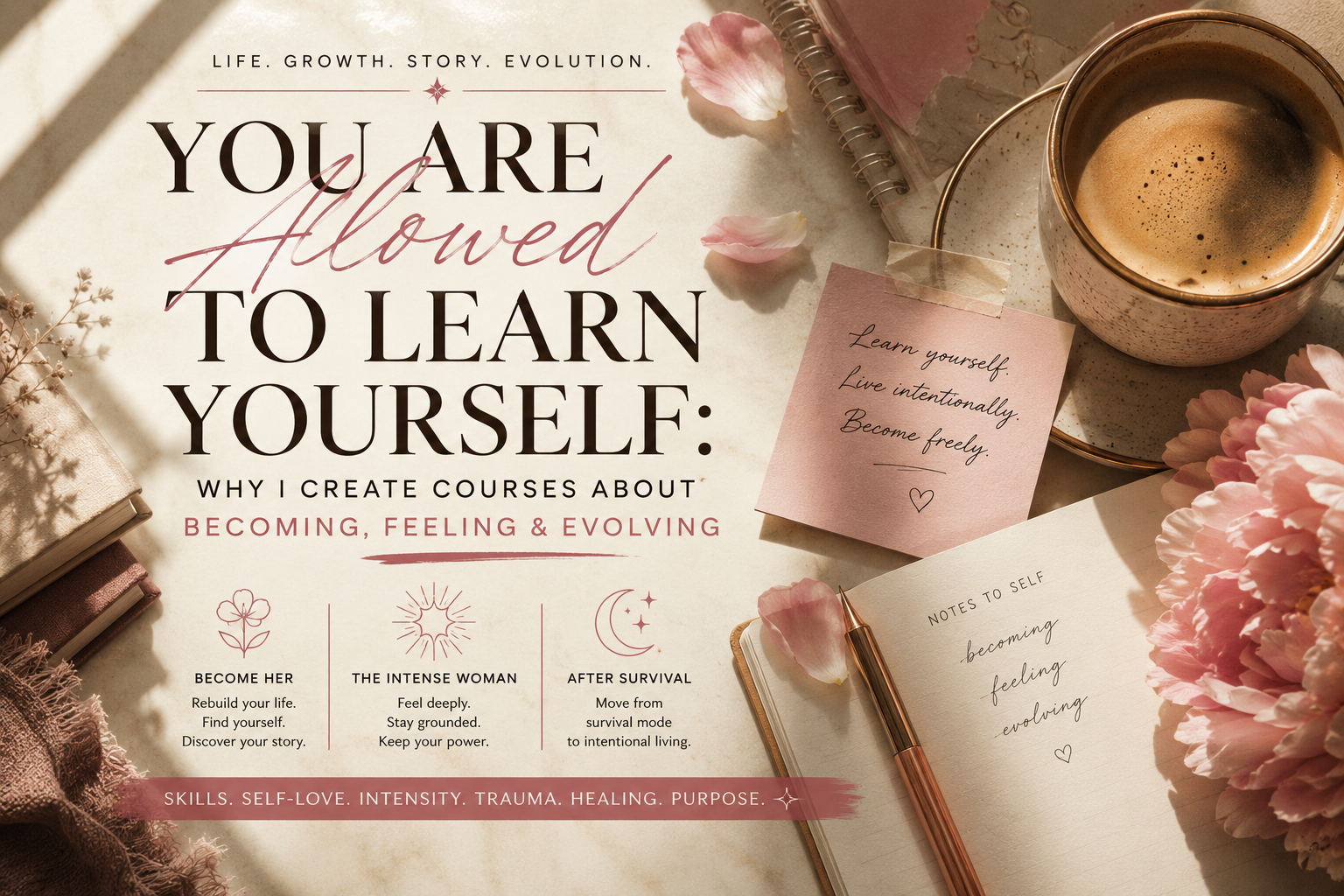
That’s the philosophy behind Becoming Her: The Art of Rebuilding Your Life, Finding Your Story & Making Life Interesting Again.
It explores identity, but it also explores curiosity. Because I don’t think finding yourself happens exclusively through introspection.
Sometimes you find yourself by going somewhere you’ve never been. Reading something you normally wouldn’t read.
Taking yourself to dinner.
Trying a hobby you’re terrible at.
Changing your clothes.
Learning photography.
Writing.
Making something.
Talking to different people.
Studying something simply because you’re fascinated by it. Living gives you information about yourself.
And the more you experience, the more material you have—not only for creativity, but for understanding who you actually are.
Your Life Is Also Material
As a writer, I’ve learned that stories don’t always announce themselves.
Sometimes something happens and you immediately know:
I’m going to write about this.
Other times, you don’t understand the significance of an experience until years later.
A childhood memory.
A dress.
A conversation.
A relationship.
A mistake.
A photograph.
A place you used to live.
Something somebody said once that you somehow never forgot.
These things become material.
Not because every private moment needs to become public content.
I actually believe the opposite.
Some experiences should remain completely ours.
But learning how to observe your own life changes the way you experience it.
You begin asking better questions.
What did that teach me?
Why did I react that way?
What did I believe then?
What do I believe now?
What detail do I remember most?
Why did that moment stay with me?
That’s where storytelling begins.
And that’s another part of Becoming Her: learning that an interesting life isn’t necessarily an extraordinary life.
An interesting person is often simply someone who has learned to be interested.
Interested in people.
Interested in art.
Interested in culture.
Interested in ideas.
Interested in the world.
Interested in herself.
But Becoming Also Requires Emotional Skill
Curiosity and reinvention are beautiful.
They’re also only part of being human.
Because you can build an interesting life and still have difficult emotions.
You can become confident and still experience rejection.
You can love yourself and still get angry.
You can know your worth and still become jealous.
You can be emotionally intelligent and still occasionally want to send the text you absolutely should not send.
Human beings are messy.
I am much more interested in learning how to work with that reality than pretending emotionally evolved people stop having intense emotions.
That idea became part of the thinking behind The Intense Woman: How to Feel Deeply Without Losing Yourself.
Intensity itself isn’t automatically a flaw.
Some people love intensely.
Create intensely.
Think intensely.
Feel disappointment intensely.
Experience attraction intensely.
Care intensely.
The question becomes:
Do I possess the skills to hold what I feel?
Because feeling something and acting on it are two different things. An emotion can be real without every conclusion created by that emotion being true.
Anger can contain information without needing destruction.
Jealousy can reveal insecurity, fear, desire or unmet needs without becoming control.
Attraction can be powerful without becoming obsession.
Sadness can be honored without becoming an identity.
Learning emotional skills isn’t about becoming less passionate.
It’s learning to create enough space between feeling and action that you still get to choose who you want to be.
That, to me, is power.
Sometimes We Also Have to Learn Life Beyond Survival
There is another kind of becoming that interests me deeply.
What happens when you’ve spent so much time getting through things that you don’t actually know what to do when you’re finally allowed to build?
Survival teaches skills.
Some are extraordinary.
Resourcefulness.
Independence.
Observation.
Adaptability.
Persistence.
The ability to keep moving when circumstances aren’t ideal. But adaptations developed during difficult periods don’t always translate perfectly into peaceful ones.
Sometimes you become so accustomed to anticipating problems that stability feels unfamiliar.
Sometimes receiving help feels uncomfortable.
Sometimes rest feels irresponsible.
Sometimes you know exactly how to function during chaos but have no idea what to do with an ordinary Tuesday afternoon.
That’s where After Survival: Learning How to Live When You’re Used to Surviving begins.
Not with the idea that someone’s past needs to disappear.
And not with the promise that a course can treat trauma or replace professional mental-health care.
It can’t.
The question I’m interested in is different:
What skills do we need when we’re no longer trying only to make it through the day?
How do you create routines?
How do you experience rest?
How do you allow yourself pleasure?
How do you develop hobbies?
How do you receive healthy relationships?
How do you create stability?
How do you stop organizing your entire future around preventing your past from happening again?
How do you move from constantly asking—
“How do I survive this?”
—to finally asking—
“What do I want to build?”
There is an enormous difference between those two questions.
Self-Love Needs Skills
This is ultimately what connects all three courses for me. I love conversations about self-love. But I think self-love becomes far more meaningful when it moves beyond how we feel about ourselves and begins affecting how we live.
Self-love can look like learning emotional regulation.
It can look like saying no.
Trying again.
Leaving.
Apologizing.
Changing your mind.
Learning something new.
Making the doctor’s appointment.
Taking yourself somewhere.
Choosing better relationships.
Creating stability.
Allowing yourself to be a beginner.
Developing interests.
Keeping promises to yourself.
Asking for help.
Recognizing when something is beyond your expertise. Not responding immediately. Giving yourself another chance after making a terrible decision. Building a life you don’t constantly need to escape from.
Sometimes self-love is soft.
Sometimes it’s uncomfortable.
Sometimes it’s incredibly ordinary.
I Want Education to Give People Something They Can Use
That’s what I want my courses to become.
I don’t want someone to finish a lesson feeling inspired for twenty minutes and then return to their life with no idea what to do differently.
I want exercises.
Experiments.
Questions.
Skills.
Writing.
Practice.
Reflection.
Things you can actually take into a conversation, a relationship, a creative project or an ordinary Wednesday.
Becoming Her asks:
Who am I becoming, and what kind of life would allow me to discover her?
The Intense Woman asks:
Can I honor the depth of what I feel while still choosing what I do with it?
After Survival asks:
What could I build if my entire identity no longer had to revolve around getting through something?
Three different questions.
But underneath them is the same belief:
You are allowed to learn yourself.
You are allowed to discover that something you learned years ago doesn’t serve you anymore.
You are allowed to become interested in new things.
You are allowed to develop skills you weren’t taught.
You are allowed to tell your story differently once you understand it differently.
You are allowed to be intense without being consumed by your intensity.
You are allowed to have a past without making it the only interesting thing about you.
And you are allowed to build a future that introduces you to versions of yourself you haven’t met yet. I don’t think becoming is about finally arriving at the perfect version of yourself. I think it’s about becoming increasingly capable of participating in your own life.
And perhaps that’s the kind of self-love I’m most interested in:
not simply loving the woman you are, but caring enough about her to keep teaching her how to live.
Leave a Reply