
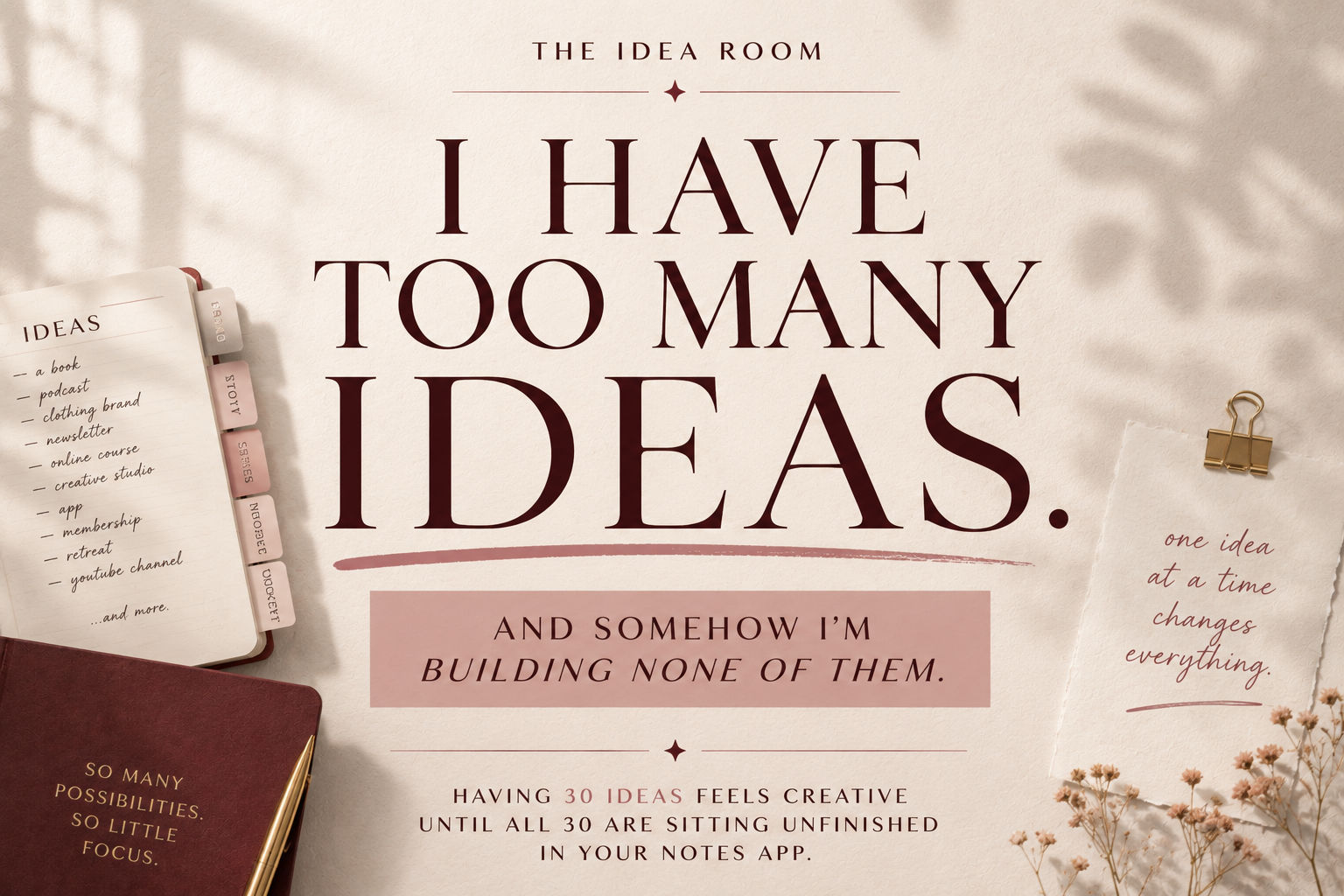
Having 30 ideas feels creative until all 30 are sitting unfinished in your Notes app.
I have never had a shortage of ideas. If anything, I’ve had the opposite problem. One thought becomes five.
I can start thinking about an article and somehow end up imagining a book, a website, a product, a photoshoot, a campaign, a completely separate brand and three things I could create two years from now.
I have notes inside notes. Screenshots I saved because they sparked something. Half-written concepts.
Names with no businesses attached to them.
Businesses with no names.
Articles that became projects.
Projects that became brands.
Random sentences that I was convinced would become something eventually. And for a long time, I thought this was simply what being creative looked like.
I have so many ideas.
It sounded like a good problem to have. Until I started realizing something uncomfortable.
I had a lot of ideas.
But that didn’t necessarily mean I was building them. Sometimes having too many ideas actually made it harder to create anything at all. Because when everything feels exciting, everything feels important. And when everything feels important, you have no idea what deserves your attention first.
That’s when I realized:
Maybe I didn’t have an idea problem.
I had a hierarchy problem.
Creativity and Execution Are Two Different Skills
Being able to generate ideas is a creative skill.
Being able to decide which idea deserves your time is another one entirely. I think multi-passionate people sometimes confuse the two. We’re naturally rewarded by possibility. The beginning is exciting.
You imagine what something could become.
You name it.
You picture the website.
You think about the audience.
You imagine yourself doing it.
You create the Pinterest board.
You tell someone about it.
Suddenly your brain has already built an entire future around something that technically doesn’t exist.
Then comes the less glamorous part.
Research.
Structure.
Writing.
Editing.
Creating the actual product.
Figuring out pricing.
Building the website.
Testing.
Marketing.
Repeating yourself.
Doing something after the novelty has disappeared. And that’s usually around the time another idea walks into the room looking much more exciting. So you follow her instead.
Now you have two unfinished projects.
Then four.
Then seven.
Eventually you’re surrounded by beginnings.
“I’m Multi-Passionate” Can Become an Excuse
I genuinely believe some people are built to have multiple creative interests.
I am one of them.
I don’t want one creative identity.
I don’t believe everything I’m interested in needs to collapse into one perfectly understandable career.
Writing interests me.
Fashion interests me.
Storytelling interests me.
Brands interest me.
Creative direction interests me.
Identity interests me.
Building things interests me.
There are ideas I want to explore simply because I’m curious about them. I’ve stopped trying to convince myself that one title will eventually contain all of me.
But being multi-passionate doesn’t mean every idea deserves to become a project.That’s where I think we can get ourselves into trouble.
Sometimes:
“I’m just a person with a lot of interests”
quietly becomes:
“I never have to choose.”
And unfortunately, creation requires choosing. You don’t have to choose forever.
But you do have to choose for now.
Not Every Idea Needs a Business
This one freed me.
Because creative people have been taught to monetize everything.
You enjoy something?
Start a business.
You know something?
Make a course.
You wrote something?
Turn it into a newsletter.
You like fashion?
Start a clothing brand.
You like cooking?
Make content.
You have an interesting thought?
Build a platform around it.
Suddenly every curiosity becomes an entrepreneurial obligation. And that’s exhausting.
Some ideas are businesses.
Some are articles.
Some are hobbies.
Some are experiments.
Some are social posts.
Some are things you should research for six months.
Some are collaborations.
Some belong inside something you’ve already created.
Some are simply interesting thoughts.
And some ideas should remain in your Notes app forever. That’s not failure.
An idea doesn’t have to become a company to have value.
I Started Asking: What Kind of Idea Is This?
This changed the way I think about creativity.
Instead of immediately asking:
“How do I make this?”
I started asking:
“What is this?”
Is it a business?
A product?
An article?
A series?
A service?
A book?
A campaign?
A hobby?
A future project?
A feature inside an existing project?
A curiosity I want to explore?
Because sometimes the reason an idea feels overwhelming is that you’ve assigned it the wrong size. You have one interesting thought and suddenly you’re imagining an entire company around it.
Maybe it isn’t a company.
Maybe it’s a really good article.
And that’s enough.
Other times, you keep treating something like a little side project when there’s clearly a much larger world inside it.
The job isn’t simply to have ideas. The job is to learn how to read them.
My Ideas Needed Somewhere to Go
I think one of the reasons creative people feel mentally cluttered is because every idea lives in the same place.
Urgent idea.
Future idea.
Business idea.
Random thought.
Article title.
Product concept.
Something you might do next week.
Something you might do in 2032.
They’re all sitting beside each other in the Notes app like they have equal importance.
They don’t.
So instead of keeping one endless list titled:
IDEAS
I think ideas need categories.
NOW
Ideas that directly support what you’re currently building.
These get your active attention.
NEXT
Strong ideas that make sense, but not until the current priority has more structure.
These are not abandoned.
They’re waiting.
LATER
Interesting concepts with potential but no immediate reason to pursue them.
INSIDE SOMETHING ELSE
Ideas that don’t need to become independent projects because they belong inside an existing brand, business, series or body of work.
JUST BECAUSE
Ideas you’re allowed to explore without turning them into anything profitable or productive.
That last category matters.
Creativity needs somewhere to exist without being evaluated for its earning potential.
The Question Isn’t “Which Idea Is Best?”
This is where choosing becomes difficult. Because sometimes you have several genuinely good ideas.
You’re not choosing between:
good idea versus terrible idea.
You’re choosing between:
good idea versus good idea versus good idea versus another good idea.
So asking “Which one is best?” doesn’t necessarily help.
I prefer different questions.
Which idea belongs to the season I’m currently in?
Which idea supports something I’ve already committed to?
Which one am I willing to work on after the exciting part ends?
Which idea has the clearest next step?
Which one requires resources I actually have right now?
Which idea am I genuinely curious about—not just excited to announce?
Which one would still interest me if nobody knew I was building it?
And one of my favorites: If I couldn’t start anything new for six months, which existing idea would I finally develop properly?
If I couldn’t start anything new for six months, which existing idea would I finally develop properly?
That question will expose you.
Sometimes New Ideas Are Procrastination Wearing Lip Gloss
I know.
It’s painful.
But sometimes the new idea isn’t arriving because you’re an unstoppable creative genius. Sometimes the existing project has become difficult. The new idea doesn’t have problems yet.
It doesn’t have analytics.
It hasn’t failed.
Nobody has ignored it.
You haven’t discovered how much work it requires. It’s still perfect because it exists entirely in your imagination. Meanwhile, the thing you’ve already started needs you to make decisions.
It needs consistency.
It needs editing.
It needs promotion.
It needs you to keep showing up after the fantasy stage. And suddenly your brain says:
Wait. I have an even better idea.
Do you?
Or are you bored?
Are you afraid?
Did the current project become real enough to disappoint you?
Are you avoiding finishing because finished things can be judged?
Those are different problems.
A new project won’t necessarily solve them.
Finishing Is a Creative Skill Too
We romanticize idealization. The napkin sketch. The 2 a.m. revelation. The brilliant concept. The sudden burst of inspiration.
But there is another kind of creativity that gets much less attention. The creativity required to stay.
To revise.
To simplify.
To solve problems.
To make version two.
To work around limitations.
To figure out why something isn’t connecting.
To take an idea that was exciting in your imagination and make it interesting in reality.
That’s development.
And I’ve become increasingly interested in development because the first version of an idea is rarely the most interesting version of it.
The first idea is the doorway.
You still have to enter the room.
This Is Part of Why I Created The Idea Room
The more projects I’ve developed, the more I’ve realized that sometimes creative people don’t need another tutorial.
They don’t necessarily need someone to tell them exactly what business to start. Sometimes they need somewhere to put all the pieces on the table and actually look at them.
That’s what inspired The Idea Room.
It’s a private creative development session for the person who says:
“I have too many ideas.”
“I don’t know which direction makes sense.”
“I can see what I want, but I can’t explain it.”
“I have the beginning of something.”
“I don’t know if this should be a brand, project, series or product.”
“I keep starting things and can’t figure out which one deserves my attention.”
You bring me the messy version.
We talk through it.
We look for connections.
We question assumptions.
We find what’s actually interesting.
We identify what belongs together and what doesn’t.
Because sometimes the problem isn’t that you need more ideas.
You need someone to help you see the shape of the ones you already have.
Your Ideas May Be More Connected Than You Think
This is another thing I find fascinating.
Creative people often describe their interests as random because they look unrelated on the surface.
Fashion.
Writing.
Psychology.
Photography.
Relationships.
History.
Beauty.
Culture.
Business.
Storytelling.
You look at the list and think:
What am I supposed to do with all of this?
But if you go underneath the subjects, sometimes there’s a pattern.
Maybe you’re fascinated by identity.
Maybe you’re obsessed with transformation.
Maybe you care about memory.
Maybe you’re interested in how people express themselves.
Maybe you keep returning to beauty.
Maybe you constantly explore belonging.
Maybe every project you’ve imagined is secretly asking the same question through a different medium.
That’s where things become interesting. Because instead of forcing yourself to choose one interest, you can start identifying the thread connecting them.
That’s something we can explore inside The Idea Room, too.
Not necessarily:
Which part of yourself should you eliminate?
But:
What are all these parts trying to build together?
You Need One Main Character
This is probably the simplest way I think about creative hierarchy. Your ideas can all exist. They just cannot all be the main character at the same time.
One gets the spotlight.
A few can play supporting roles.
The others wait backstage. That’s not abandoning them. It’s sequencing them. Maybe this quarter, you’re building the business.
The podcast goes into NEXT.
The book goes into LATER.
The article supports the business.
The photography project stays JUST BECAUSE.
Suddenly, you haven’t lost any part of yourself.
You’ve simply stopped demanding that every part of yourself launch simultaneously. And that creates room to actually finish something.
Your Notes App Isn’t a Graveyard
I don’t think we should look at unfinished ideas with shame.
Sometimes an idea simply arrived before its time.
Sometimes you needed to become more skilled.
Sometimes the technology wasn’t there.
Sometimes your audience wasn’t there.
Sometimes you weren’t there yet.
And sometimes you’ll revisit something two years later and realize:
Oh. Now I understand what this was supposed to be.
So keep the archive.
Write the weird idea down.
Save the name.
Record the voice memo.
Take the screenshot.
Protect your curiosity.
But stop treating every spark like an emergency.
You don’t have to build everything today.
You don’t even have to build everything you’ve imagined.
The goal isn’t to empty your Notes app.
The goal is to become better at recognizing:
This one deserves me now.
Maybe You Don’t Have Too Many Ideas
Maybe you have exactly the kind of mind you’re supposed to have.
Curious.
Associative.
Restless.
Imaginative.
Able to see possibility everywhere.
That’s beautiful.
But possibility needs structure if you want it to become something tangible. Your creativity doesn’t need to become smaller. It needs somewhere to go.
A hierarchy.
A sequence.
A container.
A decision.
And sometimes another mind in the room.
That’s why The Idea Room isn’t about giving you more ideas.
You probably have enough. It’s about sitting across from the ideas you’ve already collected and asking:
Which one are we actually going to build?
The Idea Room — with Destinie Dianne
Bring the unfinished idea.
The Idea Room is a private creative development session for writers, creators, founders and multi-passionate people who need another creative mind in the room.
Bring the Notes app.
Bring the half-developed brand.
Bring the project you can’t explain.
Bring the five ideas competing for your attention.
Bring the thing you keep saying you’re going to start.
You don’t need a polished pitch.
Bring me the messy version. We’ll see what’s hiding inside it.
Leave a Reply