
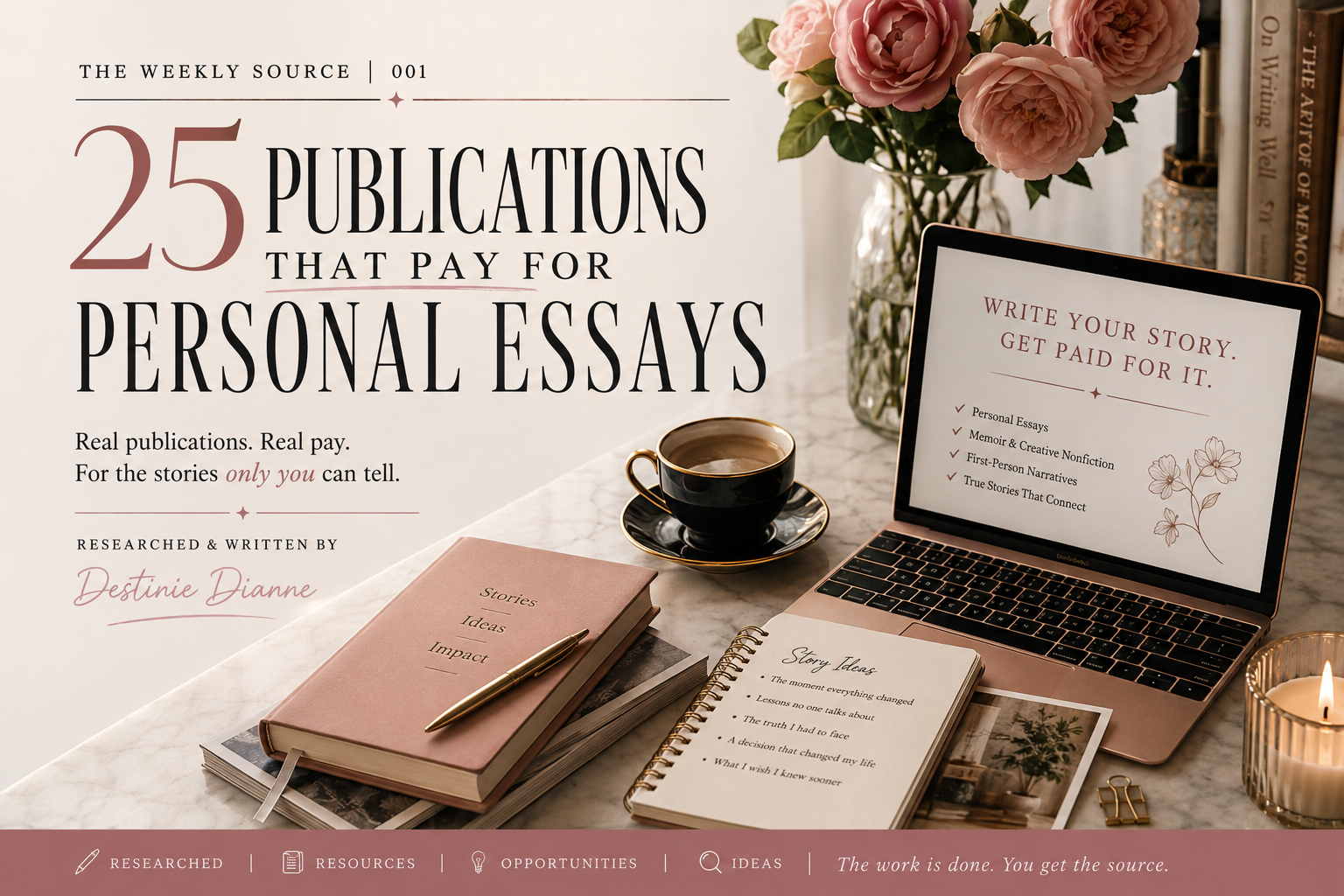
THE WEEKLY SOURCE · 001
You already lived the story. Here’s where you might actually get paid to tell it.
Researched & written by Destinie Dianne.
THE WEEKLY SOURCE
Research, resources, opportunities & ideas you don’t have time to find yourself.
If you’ve ever written something deeply personal and then wondered:
Okay…what am I supposed to do with this?
This week’s Source is for you.
Personal essays occupy an interesting corner of the writing world because you don’t necessarily need a journalism degree, a book deal, or ten years of professional writing experience to have something worth publishing.
Sometimes your qualification is that you lived it.
A relationship.
A strange childhood.
Starting over.
Motherhood.
Grief.
Race.
Identity.
Money.
Religion.
Work.
Sex.
Family.
A career change.
A decision that changed everything.
A place you couldn’t forget.
Something embarrassing.
Something hilarious.
Something that took you ten years to understand.
The personal essay takes an individual experience and turns it into something another person can recognize themselves inside.
And yes—publications still pay writers to do that.
So I went looking.
I wanted publications where personal experience, memoir, first-person narrative or literary creative nonfiction has a real place—not content mills looking for 1,500 SEO words for $12.
Below are 25 publications and markets worth researching if you have a true story to tell.

A note before you pitch
Rates, submission windows and editorial needs change constantly. This Source was researched in August 2026, but always click through to the publication’s current guidelines before submitting.
Also pay attention to the difference between:
PITCH FIRST — send the idea before writing/submitting the entire article.
and
FULL DRAFT — they want to see the completed essay.
That distinction matters.
Let’s get into it.
Best for: Beautifully written long-form personal narratives, memoir, culture, identity, unusual experiences and stories with an unexpected angle.
Pay: $500 for personal essays.
What I found: Longreads specifically says it publishes personal essays and looks for compelling voices and unexpected approaches across a wide range of subjects.
There’s one important catch:
Personal essays must be submitted as completed, polished drafts.
This isn’t the place to send three paragraphs explaining what you might write.
Their current guidelines distinguish personal essays from reported and critical essays, which can be pitched. Personal essays are considered on spec.
Destinie’s note: If you have one exceptionally strong personal essay—the kind you’ve revised ten times and still can’t stop thinking about—I’d put Longreads high on the list.
Difficulty: ★★★★★
Submission type: Full draft
Potential angle: Don’t simply tell them what happened. Ask yourself what your experience reveals that the reader hasn’t considered before.
SOURCE: Longreads Submission Guidelines
Best for: Love, dating, marriage, divorce, intimacy, family, parenthood and unconventional relationships.
Modern Love is probably one of the most recognizable destinations for personal essays about relationships.
But don’t interpret “love” too narrowly.
The column has historically explored the strange, complicated and sometimes uncomfortable ways humans form attachments.
Think beyond:
“I went through a breakup.”
Think:
What did this relationship teach me about something I misunderstood about love?
Modern Love uses submission windows rather than remaining continuously open, so this is one you’ll want to bookmark and revisit.
Difficulty: ★★★★★
Submission type: Completed essay during designated submission periods.
Potential angle: The more specific the story, the better. “What heartbreak taught me” is broad. The bizarre ritual you continued performing six months after your breakup because you couldn’t admit it was over? Now there’s a story.
SOURCE: New York Times Modern Love submission information
Best for: Personal experiences involving careers, money, work, education, relocation, parenting, relationships and lifestyle decisions.
Business Insider is particularly interesting because the personal story doesn’t necessarily need to sound “literary.”
Their first-person pieces often have a strong premise:
I did X. Here’s what happened.
That makes this a useful market for writers whose lives intersect with career, money or unconventional decisions.
Think:
I Left My Corporate Career at 35. Here’s What I Wish I’d Known.
I Moved Back Home After Living Alone for 10 Years.
I Have Three Careers Instead of One. Here’s Why I Stopped Trying to Choose.
Pay: Rates vary; current freelance-market reporting puts many personal essay assignments in the $200+ range, but confirm your rate before accepting an assignment.
Difficulty: ★★★★
Submission type: Pitch
Destinie’s note: Study their headlines before pitching. Their style is extremely recognizable.
SOURCE: Business Insider freelance/pitch guidelines
Best for: Literary memoir, family, relationships, identity, loss, transformation and the complicated parts of being human.
If your writing is intimate, vulnerable and literary, research The Sun.
This isn’t the place I’d send a generic advice article.
They want writing with voice.
Writing that feels lived.
Writing where something is at stake.
They publish essays, fiction, interviews and poetry and compensate published contributors.
Difficulty: ★★★★★
Submission type: Finished work
Potential angle: Look for the story you’ve been afraid might be too specific or personal. Specificity is often exactly what makes an essay universal.
SOURCE: The Sun submission guidelines
Best for: Identity, psychology, personal transformation, life changes and experiences that fundamentally shifted your perspective.
This one immediately caught my attention.
Psyche has a format called:
Turning Points: First Person.
These are personal essays of roughly 1,200–1,800 words centered around change.
And “change” can mean something enormous or seemingly ridiculous.
Their description suggests they want stories you might tell around a dinner table or campfire—the kind where something happened and afterward you weren’t quite the same.
Psyche pays professional writers a freelance fee and other contributors an honorarium, with the amount disclosed before contract.
Important: They want a pitch, not a completed draft.
Difficulty: ★★★★
Submission type: Pitch
Destinie’s note: This could be particularly good for writers interested in personal growth who don’t want to write generic “5 ways to heal yourself” content.
SOURCE: Psyche writer guidelines
Best for: Literary creative nonfiction, memoir excerpts and beautifully crafted personal essays.
CRAFT is one of the clearest paying opportunities I found.
Their general creative nonfiction submissions are open year-round.
Current pay:
$200 — long-form creative nonfiction
$100 — flash creative nonfiction
Long-form work can run approximately 1,000–6,000 words, while flash is under 1,000.
General submissions are free.
They also run contests throughout the year with significantly larger prizes.
Difficulty: ★★★★
Submission type: Full manuscript
Destinie’s note: CRAFT cares about exactly what its name suggests—the actual craft of the writing. Voice, structure, language and storytelling matter.
SOURCE: CRAFT submission guidelines
Best for: Creative nonfiction, identity, womanhood, culture, relationships and literary personal writing.
Room publishes work by writers of marginalized genders and has a long history of publishing creative nonfiction alongside fiction and poetry.
For regular submissions, creative nonfiction can be up to approximately 3,500 words.
Pay: Currently up to $200 CAD, calculated by published page count, plus contributor copies and a subscription.
They also run a Creative Non-Fiction Contest with larger prizes.
Difficulty: ★★★★
Submission type: Full manuscript
SOURCE: Room submission guidelines
Best for: Life experiences, lessons learned, challenges, success stories and relatable personal narratives.
HERS explicitly accepts personal essays.
Their guidelines describe wanting evocative narrative writing about the writer’s life that entertains, informs or inspires.
Length: Approximately 800–1,600 words.
Pay: Their current guidelines state $0.12 per word or $150 flat, whichever is greater.
There is a small reading fee for non-subscribers, so factor that into your decision before submitting.
Difficulty: ★★★
Submission type: Completed essay
SOURCE: HERS Magazine submission guidelines
Best for: Travel, place, strangers, journeys and personal stories where location matters.
This is NOT your typical:
“10 Things to Do in Paris”
travel publication.
Off Assignment is interested in the person inside the journey.
Their editors describe looking for essayists with a sense of place, writers fascinated by strangers and stories where the writer actually appears on the page.
If something happened while traveling that changed how you understood yourself, another person or a place, research them.
Difficulty: ★★★★
Submission type: Varies by category/current call.
SOURCE: Off Assignment submissions
Best for: Black women writing personal, emotionally resonant narratives.
This is one I’d especially bookmark if you’re a Black woman essayist.
midnight & indigo publishes work by Black women writers and periodically opens calls specifically for narrative and personal essays.
A recent 2026 personal-essay call sought unpublished first-person work with a minimum length of 1,200 words.
Pay: The 2026 essay call paid $150 per accepted essay.
Important: Their most recent essay window has closed, so this is a watch-for-the-next-call opportunity rather than something to submit to today.
Difficulty: ★★★
Submission type: Full manuscript during open calls
SOURCE: midnight & indigo submission calls
Best for: First-person experiences connected to a larger cultural, political or newsworthy conversation.
The Guardian isn’t looking for diary entries.
But your personal experience can become the foundation of an argument.
Their US Opinion guidance specifically includes first-person stories tied to news alongside traditional persuasive opinion pieces.
That means your question becomes:
Why does my experience matter right now?
Their US freelance charter currently lists payment for commissioned written contributions, with separate rates depending on format.
Difficulty: ★★★★★
Submission type: Pitch first
Destinie’s note: Don’t send your whole life story. Give the editor the argument, why you’re the person to tell it and why the story matters now.
SOURCE: Guardian Opinion pitch guidelines + freelance charter
Best for: Parenthood, motherhood, family identity and cultural conversations surrounding parenting.
Romper accepts freelance pitches for essays and reported pieces.
Their personal essay guidance emphasizes having an actual story, rather than merely a subject.
That’s an important distinction for every publication on this list.
“I want to write about motherhood.”
is a topic.
“The first time my daughter repeated something I hated hearing my own mother say.”
is the beginning of a story.
Difficulty: ★★★
Submission type: Pitch
SOURCE: Romper pitching guidelines
Best for: Parenthood, family, motherhood, fatherhood and the identity changes that happen through raising children.
Motherwell’s entire premise is telling different sides of the parenting experience.
They have historically published personal essays, perspective pieces and reflective writing that goes beyond parenting advice.
Reported pay: Around $50 for selected personal essays, though writers should confirm the current amount before agreeing to publication.
Difficulty: ★★★
Submission type: Watch current submission calls/guidelines.
Best for: Personal experience, identity, perspective and stories that matter deeply to the writer.
Lived In describes itself as a home for personal essays, poetry, fiction and film from creators around the world.
Most importantly for this list:
They explicitly state that they pay contributors.
They also accept work in English and Spanish, with other languages considered case by case.
Difficulty: ★★★
Submission type: Check current call
Destinie’s note: This is exactly why I like researching beyond the household-name magazines. Smaller publications can be much more approachable places to build clips.
Best for: Literary personal essays and creative nonfiction.
Black Fox specifically asks for personal essays and creative nonfiction that read with the narrative pull of fiction.
Maximum length is approximately 5,000 words.
Pay: Currently $20 for accepted contributors.
No, it’s not life-changing money.
But remember that every opportunity doesn’t serve the same purpose.
A smaller literary publication can provide:
a byline + publication credit + portfolio clip + editorial experience.
That can help you pitch the $500 opportunity later.
Difficulty: ★★
Submission type: Completed manuscript
Best for: Personal essays about adversity, difficult human experiences and overcoming what has haunted you.
Trigger Warning accepts memoir, personal essays, creative nonfiction and other literary work centered around human trials and overcoming difficult experiences.
Pay: Their guidelines list $25 for accepted work, plus a contributor copy.
There is also a reading fee.
Current status: No open calls at the time of this research.
So don’t submit now.
Bookmark it.
This is exactly why checking submission status matters.
Best for: Literary creative nonfiction.
The Tributary publishes fiction, poetry and creative nonfiction.
Pay: Their listed prose rate is $0.08 per word.
Creative nonfiction can run approximately 1,000–5,000 words.
Current status: Submissions are closed at the time of this Source, with future issues planned.
Another one for your watchlist.
Best for: Literary and flash creative nonfiction.
Blue Earth Review is worth watching for both regular opportunities and contests.
At the time of this Source, its 2026 Flash Creative Nonfiction Contest is open through August 21, 2026.
Maximum length: 750 words per piece.
Prize: $500 + publication for the winner.
Entry fee: $5.
This is technically a contest rather than guaranteed publication payment, so I’m separating it from standard freelance rates—but it’s a timely opportunity personal essayists may want to know about.
SOURCE CHECKED: August 2026.
Best for: Personal stories connected to social change, community, justice, culture, solutions and the way larger systems affect ordinary lives.
YES! is worth researching when your personal story connects to something bigger.
Think less:
“Here’s something difficult that happened to me.”
and more:
“Here’s what my experience reveals about something happening to thousands of us.”
This is where personal experience and reported/idea-driven writing can intersect.
Difficulty: ★★★★
Submission type: Pitch
Best for: Women’s lives, culture, gender, politics, relationships, identity and social issues.
DAME has historically commissioned personal essays alongside reported features and commentary.
Their sweet spot is usually not “here is my inspirational journey.”
It’s sharper.
More culturally aware.
More argumentative.
More:
This happened to me, and here’s what it says about the world women are navigating.
Difficulty: ★★★★
Submission type: Pitch
Best for: Everyday life, family, travel, community, small realizations and reflective personal experiences.
This is an interesting market because the essay doesn’t have to involve extraordinary trauma or a dramatic life event.
Sometimes the story is simply an ordinary moment observed extraordinarily well.
That’s an important reminder for personal essay writers:
Your life doesn’t need to be sensational to be worth writing about.
Difficulty: ★★★
Submission type: Check current Home Forum guidelines before submitting.
Best for: Family, motherhood, relationships, grief, faith and emotionally relatable life experiences.
Her View From Home publishes first-person pieces designed to create recognition:
I’ve felt that too.
Writers interested in emotionally accessible, conversational essays should research their current contributor program.
Compensation has historically been tied in part to readership/pageviews, so read the current terms carefully before submitting.
Difficulty: ★★
Best for: Climbing, mountains, adventure, risk, wilderness and personal experiences in outdoor culture.
This is your reminder that personal essays don’t only belong in “personal essay magazines.”
Sometimes the best market is the publication devoted to the thing your story happens to be about.
If your transformative story happened while climbing a mountain, pitch the climbing publication.
If it happened in a kitchen, investigate food publications.
If it happened while traveling, investigate travel publications.
Your subject can reveal your market.
Best for: Personal experience intersecting with politics, labor, inequality, social justice and community.
Briarpatch is another example of using lived experience as an entry point into a larger argument.
Writers with personal stories involving work, housing, identity, inequality, activism or community issues may find an angle here.
This is less “memoir for memoir’s sake” and more:
personal experience as evidence.
Difficulty: ★★★★
Best for: Remarkable true stories, overlooked experiences, unusual lives and narrative nonfiction.
Narratively built its reputation around human stories.
Their strongest pieces tend to have that:
Wait…WHAT happened?
quality.
Rather than merely being reflective, the experience itself usually gives the reader a reason to keep going.
Narratively also runs memoir opportunities and prizes. Its 2025 Memoir Prize, for example, awarded $3,000 to the winner and $1,000 to two finalists, along with publication.
That competition is now closed, so don’t confuse an old call with an active opportunity.
Instead:
Bookmark Narratively and watch for the next submission opportunity.
Difficulty: ★★★★
If looking at 25 publications just gave you 25 new tabs and decision paralysis, here’s where I’d start.
If you’re a newer writer:
HERS Magazine
Motherwell
Lived In
Black Fox Literary Magazine
Her View From Home
Build clips.
Learn what working with editors feels like.
Then move upward.
If your writing is deeply personal + literary:
Longreads
The Sun
CRAFT
Room
Off Assignment
If your essay connects your experience to a bigger idea:
Psyche
The Guardian
YES! Magazine
DAME
Business Insider
If your story involves relationships:
Start with:
Modern Love
But don’t stop there.
A relationship essay involving money might belong at Business Insider.
One involving psychology might work for Psyche.
One involving gender or politics could become a DAME pitch.
The story determines the market.
Here’s the checklist I’d run through first.
- I read at least 3–5 pieces from this publication.
- I checked that submissions are currently open.
- I checked whether they want a pitch or completed manuscript.
- I verified the current word-count requirement.
- I verified the current rate/payment terms.
- I checked whether simultaneous submissions are allowed.
- I checked whether previously published/self-published work is allowed.
- I know exactly which editor/category I’m pitching.
- My story actually fits the publication.
- My pitch explains why I should tell this story.
- I can explain what the reader gets from the story beyond knowing what happened to me.
- I followed the submission instructions exactly.
That last one sounds obvious.
But if an editor asks for:
PERSONAL ESSAY: [TITLE]
in the subject line?
Put exactly that.
Don’t make someone’s job harder before they’ve even read your work.
I want to challenge an idea that keeps a lot of aspiring writers from pitching personal essays:
You don’t need to have an extraordinary life to have an extraordinary perspective.
You don’t need to be famous.
You don’t need a giant audience.
You don’t necessarily need professional credentials.
You need a story.
And then you need to figure out:
Why this story?
Why me?
Why this publication?
Why now?
And maybe most importantly:
Why would someone who has never met me care what happened?
Answer that well enough, and you’re no longer simply telling people about your life.
You’re writing an essay.
THIS WEEK’S SOURCE CHALLENGE
Don’t bookmark all 25.
Choose three.
For each one:
1. Read five recently published essays.
2. Write down three patterns you notice.
3. List two stories from your own life that could fit.
4. Choose one.
5. Either outline the essay or write the pitch this week.
Because collecting writing opportunities isn’t the same thing as becoming a published writer.
Eventually you have to send something.
SOURCE NOTE
Information in The Weekly Source is researched before publication, but freelance rates, editorial contacts, submission windows and guidelines can change without notice. Always verify the publication’s current guidelines before submitting or agreeing to an assignment.
Research checked: August 2026.
THE WEEKLY SOURCE
Researched & written by Destinie Dianne.
Research, resources, opportunities & ideas you don’t have time to find yourself.
Leave a Reply