
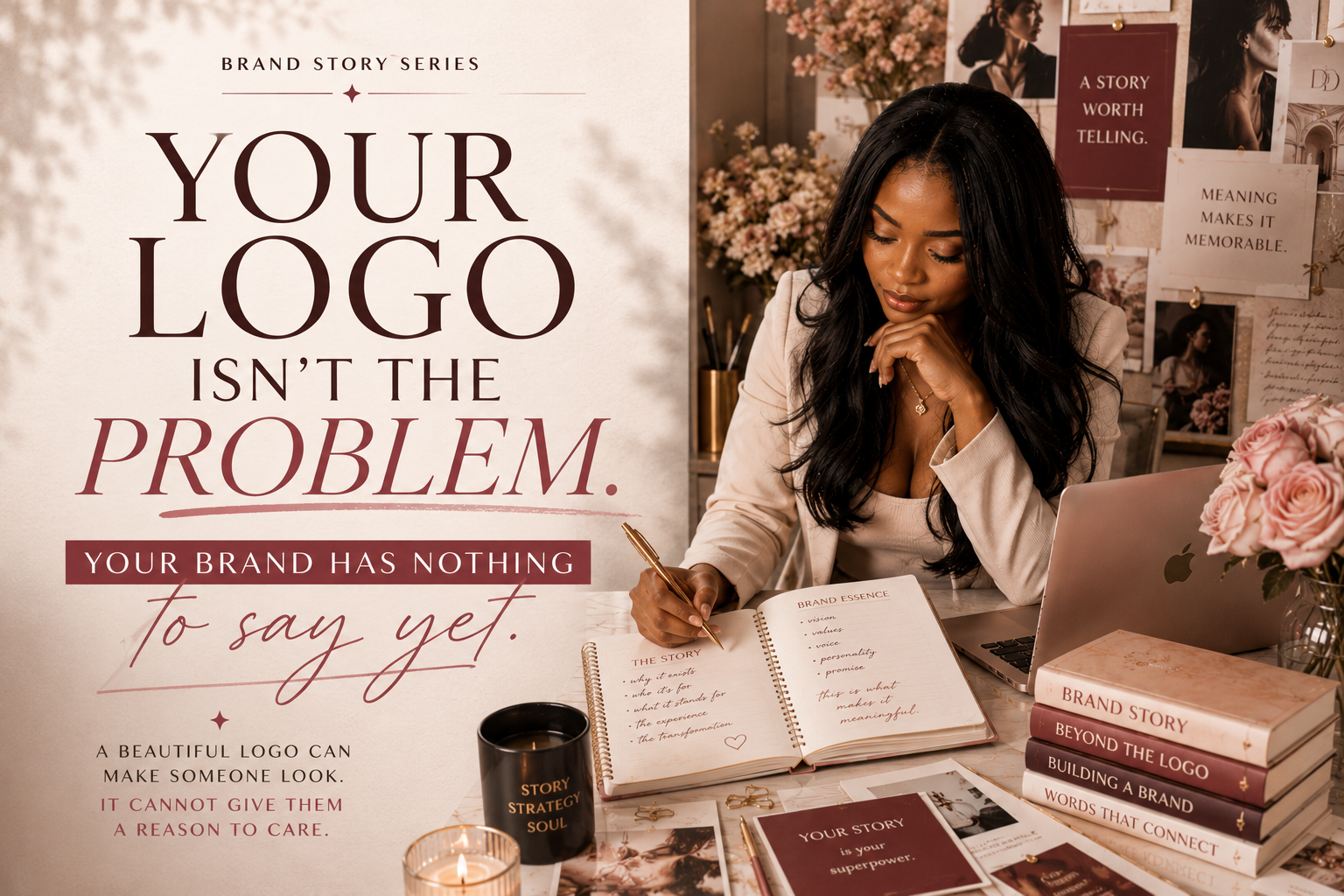
A beautiful logo can make someone look. It cannot give them a reason to care. There is a very specific stage of building a brand that I think almost every creative founder eventually reaches.
You have the name.
You have the logo.
You spent three hours deciding between two shades of pink that, according to everyone else, look exactly the same. You have twenty-seven screenshots saved for inspiration. You’ve changed your Instagram bio six times.
You bought the domain.
You found the perfect font.
Your moodboard is beautiful.
Your packaging mockup looks expensive.
Everything is starting to look like a real brand. And then someone asks the simplest question imaginable:
“So…what is your brand about?”
And suddenly, you don’t know what to say. Not because you don’t have a vision.
You probably have too much vision.
You know what you want the brand to feel like. You can imagine the photographs, packaging, website, customers, launch campaign and entire future of the company.
You know the world in your head. The problem is figuring out how to invite everyone else into it.
Building my own brands taught me something I didn’t completely understand when I started:
Having a vision and communicating a vision are two entirely different creative skills. And no amount of redesigning your logo can solve the second one.
We Keep Trying to Fix Identity Problems With Aesthetics
I love aesthetics.
I’m a visual person. Fashion, photography, color, typography, imagery and atmosphere are part of how I understand ideas.
Presentation matters. But I also think we’ve reached an interesting point in internet culture where it’s incredibly easy to make something look like a brand. Give someone Canva, Pinterest and an afternoon and they can create:
Beautiful typography.
Coordinated colors.
Mock packaging.
Editorial photography.
A sophisticated Instagram feed.
A polished website.
Suddenly, it looks legitimate.
But looking like a brand and having a brand identity aren’t necessarily the same thing. Because after I’ve admired the packaging, I still have questions.
Who are you?
Why did you create this?
What do you believe?
What do you see differently?
Why does this exist instead of the hundred other versions of it?
Who is this really for?
What do you want people to feel when they encounter you?
And perhaps most importantly:
Why should I care?
That’s where story enters.
It’s also one of the reasons I created The Brand Story Suite. I kept noticing how many founders had already created something beautiful but were struggling to articulate what existed underneath the beauty.
They didn’t necessarily need another visual identity.
They needed language for the identity they already had.
Your Logo Can Introduce You. It Cannot Explain You.
Think about what a logo actually does.
It identifies.
It creates recognition.
It gives your business a visual signature.
That’s valuable.
But your logo cannot carry the entire emotional and intellectual weight of your brand. It cannot explain why you started.
It cannot communicate the experience that changed your perspective.
It cannot tell me what frustrated you enough to create an alternative.
It cannot show me the world you’re trying to build.
It cannot communicate your humor, contradictions, obsessions, philosophy or point of view.
Your logo tells me your name.
Your products tell me what you sell.
Your aesthetic tells me how you want to look.
Your story begins telling me why I should remember you.
And I think that’s the piece a lot of new brands skip.
“We Empower Women” Isn’t a Brand Story
Neither is:
“We believe everyone deserves to feel confident.”
“We’re passionate about helping people.”
“Our mission is to inspire.”
“We provide high-quality products with exceptional customer service.”
There’s nothing inherently wrong with those statements. The problem is that almost anyone could say them. Take your company name off your website and replace it with another company’s name.
Does the sentence still work?
If it does, we probably haven’t reached your story yet. One of the most interesting questions I think a founder can ask is:
What could my brand say that would sound strange coming from somebody else?
Now we’re getting somewhere. Because specificity creates identity. Maybe your relationship with fashion began because you spent your teenage years altering thrift-store clothes because nothing in the mall felt like you.
Maybe you created a beauty company because the rituals between you, your mother and your grandmother shaped how you understood femininity.
Maybe your jewelry isn’t really about jewelry. Maybe you’re fascinated by heirlooms, memory and the objects women keep after relationships end.
Maybe you became a photographer because you’ve always noticed the moments everybody else overlooks.
Maybe your wellness business exists because you became exhausted with an industry that made ordinary women feel like projects constantly needing improvement.
Now I understand something about you.
Now I understand the world behind the product.
That’s your material.
And that’s where a business starts becoming interesting.
Your Story Doesn’t Have to Be Extraordinary
I think this is where some founders get uncomfortable.
They hear “brand story” and assume they’re supposed to manufacture some cinematic origin story.
They think they need to have overcome something enormous.
They need a dramatic childhood memory.
They need the perfect founder journey.
They need a moment where lightning struck and suddenly the company appeared.
You don’t.
Sometimes the story is incredibly ordinary.
You couldn’t find something you wanted, so you made it.
You kept noticing the same problem.
You became obsessed with a subject.
You wanted to create the kind of space you couldn’t find.
You inherited a ritual.
You became curious.
You saw something being done one way and wondered what would happen if you did it differently.
The power isn’t necessarily in how dramatic your story is.
It’s in how specifically you tell it.
That’s something I wanted The Brand Story Suite to help founders uncover.
I’m not interested in inventing a more impressive story for someone’s business.
I’m interested in finding the interesting details already there—the reason, memory, frustration, obsession, perspective or experience the founder may have overlooked because it feels ordinary to them.
Sometimes the part you almost didn’t mention is the part that makes me understand the entire brand.
People Remember Meaning
We live in an incredibly visually sophisticated time.
Consumers have seen beautiful things. They have seen luxury packaging.
They have seen minimalist websites.
They have seen pink branding.
They have seen neutral branding.
They have seen serif fonts.
They have seen gorgeous product photography.
They’ve seen the Pinterest moodboard.
Beauty is still valuable. But beauty alone isn’t rare anymore.
Meaning is harder to manufacture.
A real perspective is harder to copy.
A founder’s lived experience is harder to duplicate.
A distinctive voice is harder to reproduce.
A philosophy takes longer to develop than a color palette.
That’s why I think storytelling is becoming even more important.
When everything can look polished, the question becomes:
What exists underneath the polish?
Build a World, Not Just a Store
The brands I find most interesting don’t feel like collections of products. They feel like worlds. You begin recognizing their language.
Their references.
Their humor.
Their values.
Their imagery.
Their perspective.
Their customer isn’t merely buying an object. She’s participating in something. And this doesn’t require becoming a huge lifestyle company. A tiny independent brand can create a world. Actually, I think small brands have an incredible advantage here.
You’re closer to the beginning.
You’re closer to the reason it exists.
The founder is still visible. The story hasn’t been buried underneath twelve departments and fifty approval meetings.
You can speak like a person.
Use that.
Tell us what you’re fascinated by.
Tell us what you disagree with.
Tell us what you couldn’t find.
Tell us why you chose that name.
Tell us about the person you imagined when you created the first product.
Tell us about the mistake that changed the concept.
Tell us what you’re trying to preserve.
Tell us what you’re trying to change. Give us something to enter.
Your Brand Needs a Point of View
This might be the part I care about most. A brand should eventually develop a way of seeing things. Not controversial opinions manufactured for engagement.A genuine perspective.
What do you believe about the industry you’re entering?
What do you think people misunderstand?
What are you tired of seeing?
What do you want more of?
What does everyone else emphasize that you don’t care about?
What do you care about that everyone else seems to ignore?
Those answers become incredibly useful. They shape your articles.
Your captions.
Your campaigns.
Your product names.
Your website.
Your collaborations.
Your creative direction.
Suddenly, you don’t have to constantly ask:
“What should I post?”
Because your brand has things to talk about. That’s one of the biggest differences between a brand with an identity and a business constantly trying to produce content.
One is communicating. The other is filling space.
I Learned This by Building My Own Brands
I didn’t arrive at these ideas because I spent twenty years working inside a branding agency. I learned them by writing, creating, experimenting and trying to build worlds of my own.
I’ve experienced the strange gap between knowing exactly what something means to me and realizing nobody else lives inside my head.
I’ve had ideas I could visualize before I could explain them.
I’ve known exactly how I wanted something to feel while having absolutely no idea how to describe it.
I’ve built concepts and then realized the language wasn’t strong enough yet.
I’ve changed things.
Scrapped things.
Renamed things.
Written one sentence that suddenly made an entire concept click.And somewhere in that process, I realized that one of my favorite parts of building wasn’t only creating the thing. It was finding the language underneath the thing.
What is this really about?
Why does it exist?
What’s interesting about it?
What is the story?
What does this brand believe?
Why should somebody remember it?
That’s ultimately what led me to create The Brand Story Suite.
It’s an extension of something I’ve naturally become fascinated with as both a writer and a founder:
How do you take something someone can feel and turn it into something other people can understand?
The Brand Story Suite
The Brand Story Suite is for the founder who already has something worth talking about but hasn’t completely found the words for it yet.
Maybe the business already exists.
Maybe you’re preparing to launch.
Maybe you have the products, colors, website and vision.
Maybe you’ve been operating for a while.
But somewhere between what exists in your imagination and what your audience sees, something is getting lost.
You keep rewriting your About page.
Your bio sounds generic.
Your mission statement could belong to anyone.
You struggle when people ask what makes the brand different.
Your captions talk about products because you don’t know what else the brand should talk about. You know your brand is deeper than what your current words communicate. That’s where I come in.
Through The Brand Story Suite, I take the pieces—the founder, origin, purpose, audience, beliefs, personality and vision—and help turn them into language you can actually build around.
That includes developing elements such as your brand positioning, origin story, founder introduction, brand language, signature phrases and the central story that ties everything together.
Not corporate language.
Not meaningless branding vocabulary.
Not words designed to make a small business pretend to be a giant corporation.
Your language.
Your story.
Your world.
Because I don’t think every small brand needs to sound bigger. I think more small brands need to sound more like themselves.
Before You Redesign Everything, Ask Yourself This
If you’ve been staring at your business thinking something feels missing, don’t immediately change the logo.
Don’t automatically buy another template.
Don’t choose another font.
Don’t throw away your entire visual identity.
Close Pinterest for a minute. Open a blank page.
And ask:
What does my brand actually have to say?
Then ask:
What do we believe?
Why did I create this?
What do I notice that other people don’t?
What am I obsessed with?
What do I want people to feel here?
What would I still want this brand to say if Instagram disappeared tomorrow?
What part of my own story belongs inside this?
What should someone understand about us that they couldn’t learn by simply looking at the product?
Keep writing until the answer couldn’t belong to anybody else.
Because your logo isn’t necessarily the problem.
Your colors probably aren’t the problem. Your font isn’t the problem. You may simply have built the visual identity before discovering the language underneath it.
And that’s fixable.
A beautiful logo can make someone look. But a beautiful story gives them a reason to care.
The Brand Story Suite — by Destinie Dianne
Your brand has a story. Let’s tell it beautifully.
The Brand Story Suite is my custom storytelling experience for founders and creative brands ready to uncover and articulate the story underneath what they’ve built.
Together, your vision becomes language—and your business begins sounding as distinctive as it looks.
Leave a Reply