
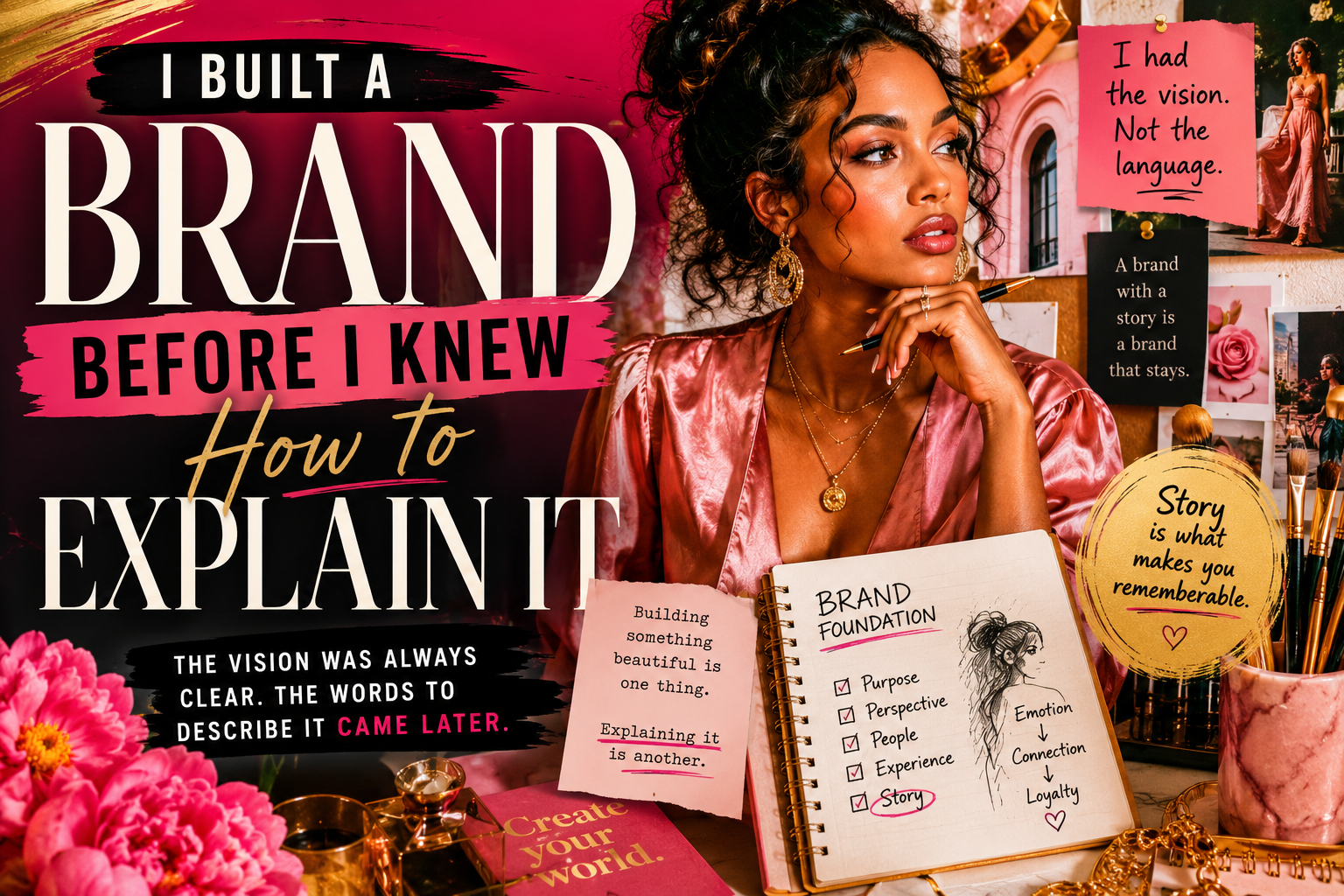
There was a long period where I knew exactly what I wanted to create. I just couldn’t explain it.
I could see the colors.
I could see the photographs.
I could imagine the website, the products, the women it would speak to, the feeling someone should have when she entered the world I was creating.
I knew what belonged. More importantly, I knew what didn’t belong.
But if you had asked me:
“So, what exactly is your brand?”
I probably would have given you a five-minute answer that somehow made less sense the longer I talked. That used to frustrate me.
Because how could something feel so clear inside of me and become so difficult the second I tried to put it into words?
Eventually, I realized:
I had the vision before I had the language. And I think a lot of creative founders are building from that exact place.
I Could See It
That’s the strange thing about being a creative person. Sometimes you don’t receive an idea as a neat business plan.
You receive fragments.
A feeling.
A photograph in your head.
A sentence.
A color.
A woman.
A problem you keep noticing.
An experience you wish existed.
A collection you can already imagine.
A name that suddenly feels right.
And somehow, all of those seemingly unrelated things make complete sense to you. That’s how many of my ideas have come to me. I don’t always start with:
Here is the market opportunity. Here is the customer profile. Here is the five-year strategy.
Sometimes I start with:
“I know what this is supposed to feel like.”
Then I build toward it.
There’s something beautiful about creating that way.
There’s also something incredibly frustrating about it.
Because eventually, someone is going to ask you to explain yourself.
Then Someone Asks, “What Do You Do?”
Suddenly, the beautiful world in your head has to become a sentence. That’s where I struggled.
I could build.
I could write.
I could create concepts.
I could imagine entire worlds around an idea.
But explaining the connection between everything was harder. Sometimes I would simplify an idea so much that it no longer sounded like mine. Other times I would over-explain because I was terrified someone wouldn’t understand.
I would keep adding context.
And another sentence.
And another.
Until something that felt incredibly clear to me suddenly sounded complicated. I thought maybe that meant the idea itself wasn’t clear. It didn’t.
My vision wasn’t necessarily confused. My language was underdeveloped.
Those are two very different problems.
When You’re Too Close to the Idea
Founders have an interesting disadvantage.
We know too much.
We know the thought that created the thought that created the business.
We know every reference.
Every abandoned version.
Every late-night realization.
Every reason we chose one word instead of another.
We understand connections our customers haven’t been around long enough to understand yet. So when someone asks us to explain the brand, we unconsciously hand them chapter seven.
Meanwhile, they’re standing at the bookstore trying to figure out what the book is about.
That was something I had to learn. People weren’t inside my head. They couldn’t see what I could see. It was my responsibility to build the bridge.
A Beautiful Brand Can Still Be Difficult to Understand
For a while, I thought the visuals could do most of the explaining. And visuals can communicate an incredible amount.
A photograph can establish mood.
A color palette can create recognition.
Typography can influence perception.
Styling can tell you who belongs inside a world before anyone says a word. I still believe deeply in all of that. But aesthetics couldn’t answer every question.
They couldn’t completely explain:
Why does this exist?
Why did you create it?
What do you believe?
Who is this for?
Why should someone care?
What connects everything you’re making?
That’s where the brand story became important. I wasn’t trying to invent meaning for something meaningless. The meaning was already there.
I needed to uncover it, organize it and communicate it.
I Thought I Needed a Better Pitch
For a while, I approached the problem like I needed the perfect elevator pitch. One clean sentence that could contain everything. But the more I learned about my own creative process, the more I realized I wasn’t really looking for a pitch. I was looking for the throughline.
The sentence underneath all the sentences.
The idea underneath all the products.
The belief underneath all the visuals.
The thing that made everything belong together.
Once I started thinking about brands that way, something shifted for me.
Instead of asking:
“How do I describe everything I do?”
I started asking:
“What connects everything I do?”
That question is much more useful. Because your brand story isn’t supposed to list every single thing you offer. It’s supposed to help someone understand the world those things belong to.
Your Brand Story Is the Thread
This is something I wish I understood earlier.
Your brand story isn’t just your biography.
It isn’t:
“I started this company because…”
and then three paragraphs about your life.
Your founder story can absolutely be part of it.
But your brand story is bigger.
It’s the thread connecting:
Your perspective.
Your customer.
Your products.
Your values.
Your visual world.
Your language.
Your content.
Your campaigns.
Your ideas.
Your future.
It’s what makes someone understand why this product came from this company. It’s what makes a new collection feel like an expansion instead of a random pivot. It’s what allows a founder with multiple interests to create without making the audience feel like they’re following five different people. That realization became especially important to me because I’ve never been someone with only one idea. I needed structure without removing the imagination.
I Had to Learn How to Translate Myself
That’s probably the best way I can describe what happened.
I didn’t need someone to give me a personality.
I didn’t need to manufacture a profound founder story.
I didn’t need to pretend there was some perfectly calculated business strategy behind every creative instinct I’d ever had.
I needed to learn how to translate what I already knew.
To take:
“I know what I mean.”
and turn it into:
“Now you know what I mean, too.”
That is a skill.
And I think creative founders underestimate how valuable it is. Because you can have an incredible idea and still struggle to communicate its value.
You can have a beautiful product and struggle to explain why it’s different.
You can have years of experience and still stare at the About page wondering what you’re supposed to say.
You can know your audience deeply and still write captions that somehow sound like everyone else’s.
You can have a brand with enormous potential and still feel like you’re constantly saying:
“No, wait. That’s not exactly what I mean.”
I know that feeling.
Sometimes You Don’t Need Another Idea
You need language for the one you already have. That distinction matters. Creative people are constantly encouraged to create more.
More content.
More products.
More offers.
More campaigns.
More ideas.
But sometimes your next level isn’t hiding inside another idea. Sometimes it’s hiding inside your ability to articulate the one you’ve already built. Because once you can explain your brand clearly, you start seeing opportunities differently.
Your website becomes easier to write.
Your About page becomes clearer.
Your content develops a perspective.
Your campaigns start connecting to each other.
Your products stop feeling isolated.
Your audience begins repeating your language back to you.
And that last part is important.
Because one of the clearest signs that your story is working is when other people can explain your brand without you standing beside them.
That’s Part of Why I Created The Brand Story Suite
My experience with my own ideas changed the way I look at other creative businesses.
When I see a founder struggling to explain her brand, my first thought isn’t necessarily:
“She doesn’t know what she’s doing.”
Sometimes I can see the opposite.
She knows.
It’s everywhere.
It’s in the photographs she saves.
It’s in the way she talks about her customers.
It’s buried inside her About page.
It’s hidden in the reason she created her first product.
It’s in the words she keeps repeating without realizing they’re important.
It’s in the world she’s already beginning to build. She just hasn’t connected the pieces yet.
That’s the thinking behind The Brand Story Suite — Storytelling for Creative Brands.
I created it for founders who already have something there.
The vision.
The idea.
The product.
The aesthetic.
The experience.
The feeling.
But when someone asks:
“What makes your brand different?”
everything suddenly becomes harder to explain.
The Brand Story Suite is about finding the story underneath what you’ve already created and giving it language.
Not turning your business into something it’s not.
Not forcing a dramatic story where one doesn’t exist.
Not filling your website with pretty words that don’t actually mean anything. Finding the truth of the brand and making it understandable.
You Don’t Need to Sound Like Everyone Else to Sound Professional
This was another lesson I had to learn.Sometimes when we don’t know how to explain ourselves, we borrow language.
We start saying things like:
“Empowering women.”
“Creating elevated experiences.”
“Authentically designed.”
“Intentional luxury.”
“Helping you become your best self.”
None of those phrases are automatically bad. The problem is that they can belong to almost anyone. If I can remove your company name, replace it with another and the paragraph still works perfectly, we probably haven’t reached your actual story yet. Your language should reveal something about how you see the world.
That’s what I now look for.
Specificity.
Perspective.
Emotion.
Tension.
Memory.
Meaning.
The details that make an idea impossible to confuse with somebody else’s.
Maybe You Already Know More Than You Think
If you’re building something and struggling to explain it, I wouldn’t immediately assume the vision isn’t there.
Look closer.
What ideas do you keep returning to?
What do people constantly ask you about?
What made you create the business in the first place?
What frustrates you about your industry?
What do you wish existed?
What do your favorite products have in common?
What do you want your customer to feel?
What kind of world are you trying to create around what you sell?
What would you still believe about this work even if it weren’t currently trendy?
There’s probably a story hiding somewhere in those answers. And once you find it, the brand begins making more sense.
Not just to everyone else.
To you.
I Could See It. I Just Couldn’t Explain It.
Looking back, I don’t think that version of me needed to become less imaginative.
She didn’t need fewer ideas.
She didn’t need to make everything more conventional so people could understand it faster.
She needed language.
She needed structure.
She needed to understand that having a vision and communicating a vision are two different creative skills.
I learned the second one because I already had the first. And now, it’s part of the work I want to do for other creative founders. Because there is a particular kind of frustration that comes from building something you know has meaning and watching people only see the surface.
You want to grab them and say:
“No. Look closer. There’s more here.”
There probably is.
The work is figuring out how to make them see it.
That’s what a brand story can do. And that’s what The Brand Story Suite — Storytelling for Creative Brands is designed to help uncover. Because sometimes you don’t need someone to give you the vision.
You already have it.
You just need the words that finally make everyone else see what you’ve been seeing all along.
Leave a Reply